




Contact Us Make a payment Check In

Importance of Developmental Reflexes

What are developmental reflexes?

reflex is an automatic and instantaneous response to a sensory stimulus. Remember when you were a child at the doctor’s office and they tapped your knee with a small mallet to check if your leg kicked upwards? You didn’t decide to kick your leg, it just kicked. There are many types of reflexes like this one and almost all of us have them. In fact, we’re born with most of them. The reflexes we are born with are called primitive reflexes and the ones we develop during the first years of life are called integrated reflexes. From infancy, reflexes are vitally important for proper development of the brain, nervous system, body and sensory systems. Some reflexes are meant to stay with us our whole lives. Others are designed to be dormant after their function is fulfilled – also called integration. Check out this awesome resource from Tools to Grow to learn more about specific reflexes and how they impact a child’s function during their daily life.

What are primitive reflexes?

Primitive reflexes are present at birth and should be integrated by 12 months to two years of age. Reflexes are the basis of our nervous system and our ability to move. Reflexes are automatic movements that happen without conscious thought that help us to survive, search for food, seek protection, avoid danger, and to walk.  Reflexes originate in the brain stem, which is the area of the brain responsible for survival. If these reflexes are not integrated, the body stays in “survival” and “stress” mode which can cause difficulty with concentration, anxiety, poor behavior, deficits in coordination, and poor performance in developmental skills and school tasks. There are many risk factors for retained primitive reflexes including, but not limited to, the following: multiple births, prematurity, c-sections, lack of tummy time, higher instances of alcohol and drug abuse, and poor awareness of developmental stages. 

What are integrated reflexes?

Integrated reflexes are important for developing motor control. A child needs motor control to maintain proper posture at a desk in school, ride a bike, read a book, cross midline, write, and get dressed. A child with integrated reflexes has normal movement patterns to complete these functional tasks at home and at school. A child with unintegrated reflexes could benefit from skilled reflex integration therapy which will essentially train a child’s brain by establishing an efficient movement pattern that supports higher level motor skills or cognitive tasks.

How do you know whether or not your child has integrated these reflexes? 

There are many common areas of difficulty that may suggest a retained reflex including the following:

  • “Bouncing” Child: Constantly moving, can’t sit still on a chair, hyperactive
  • “Noodle” Child: Leans on everything, rests head on table
  • “Shirt Chewers”: Constantly chewing on shirts or pencils, and touches everything
  • “Emotional Child”: Challenges with regulating emotions, easily frustrated or upset, difficulty with utilizing age appropriate coping strategies to calm body 
  • School Performance Challenges: difficulty with reading, handwriting, language/speech, poor sitting balance and immature grasp on writing utensils
  • Coordination Challenges: Chronic body aches, poor endurance, fatigue, muscle weakness, poor concentration, fidgeting, disorganization

What does treatment look like?

Once your Occupational Therapist suspects a retained reflex, he/she will educate the caregiver on the importance of carryover for treatment recommendations. Caregivers play an important role in seeing progression in their child’s everyday activities. It is typically recommended that the child completes a set of tailored exercises to meet your child’s needs, 5-10 minutes per day, for 30 consecutive days in order to see any progress. Your therapist may recommended a reward or sticker chart in order to keep your child motivated towards an end goal. Progress can be noted short term and over 9-12 months. In addition to exercises, your Occupational Therapist will make recommendations for modifications in the school and home environments which may include changing positioning during school work, movement breaks, sensory techniques, relaxation techniques, decreasing auditory and visual stimulation, and organizational skills, just to name a few!

In order to determine whether your child would benefit from direct treatment for Reflex Integration, it is recommended that your child be evaluated or screened by an Occupational Therapist at Carolina Therapy Connection. Give us a call at 252-341-9944 today to schedule your FREE occupational therapy screening with one of our experienced and knowledgable OT’s. 

Importance of Developmental Reflexes Carolina Therapy Connection Greenville NC

Teaching Your Child Shoe Tying

Why is learning shoe tying so important?

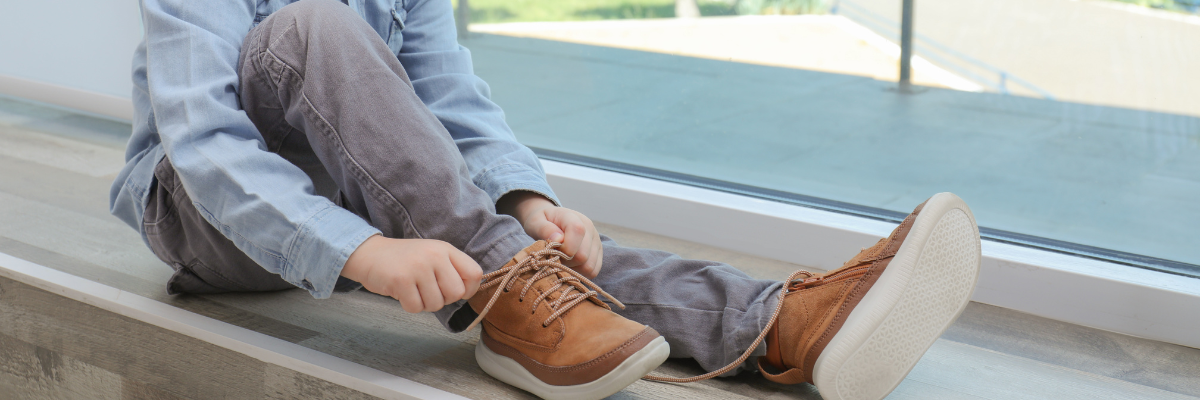
Parents typically think about tying shoes just before, or around Kindergarten. However, many children are around age 6 or older when they are ready to learn this task. This is because this task requires fine motor skills of dexterity, in-hand manipulation, and bilateral coordination. That is why it is important to make sure the child is ready for the task before introducing something too challenging or potentially discouraging. Knowing all the skills that shoe tying incorporates should also bring to light what a great opportunity shoe tying is – you can work on dexterity, in-hand manipulation, and bilateral coordination every single day! No matter what method you use, tying shoes requires learning and recalling several steps in a row. This helps to build sequencing skills, visual memory, motor planning, focus and attention to complete the task.

Why does my child want to give up on shoe tying?

When putting your shoes on, it’s typically when you need to go somewhere. In the routine of trying to get to school, a play date, the doctor, or even therapy sessions, sometimes you may be in a rush. Parents tend to buy their children shoes that have permanently tied laces, flip flops, crocs or velcro straps. Parents want to make things easier for their children. If you can avoid a struggle, why not? Although getting through the days can be tough for a parent, patience is a beautiful thing to foster in a society that can’t seem to wait for anything. Making something easier might seem good now, but not necessarily in the long run. When a child is learning how to tie their shoes in therapy, we ask that they practice a lot at home as well. This is because one time a week isn’t going to make much of a difference. The more they practice and the more they are encouraged by parents, the faster and stronger they’ll be with this challenge.

What shoe tying tips will help my child learn?

1) Learning step by step on a shoe placed in front of them (tabletop level) – It is easier for children to learn how to tie their shoes on a tabletop level before learning how to tie it on their own foot. Some children practice in a long sit on the floor with a jump rope tied around their knees so that the movements are bigger and easier to understand. Your child can also practice on your shoes to make it more fun and motivating.

2) Having different colored laces (ex. 1 black lace 1 white lace) – This way, when explaining step by step, it is visually easier on your child to understand the difference in the laces and see each step visually.

3) Practice, Practice, Practice! – It takes time! Do not think it will happen overnight. Continue to practice and they will begin to get the hang of it! Don’t give up!

4) Use Backwards Chaining Techniques

Backwards Chaining is a technique used to teach difficult tasks by breaking them down into smaller parts. Backwards chaining occurs when an adult does each step of the task and allows the kid to do the very LAST step on their own. Essentially: breaking down the steps of a task and teaching them in reverse order. This gives the child an experience of success and completion with every attempt.

Below are the verbal cues we use at Carolina Therapy Connection for each step to teach the kiddos how to tie shoes! You can substitute your own steps for alternate methods:

  1. Criss Cross or Make an X
  2. Black Under White
  3. Pull Tight
  4. Make a loop or bunny ears
  5. Push through
  6. Pull tight

5) Laces are important! – Short laces are infuriating and difficult to manage when first learning this task because the child doesn’t plan ahead to leave enough room. Round laces easily fall untied, so flat ones are usually easier. Practicing with wire ribbon or pipe cleaners can help because it keeps its shape better than laces and allows the child to loosen their grip between each step.

The Takeaway Message

There are going to be some children that just can’t master this skill, and might they have other things that are much more important for them to be working on. In those situations, adaptive laces or shoes are a wonderful option. For many children, it’s simply about finding the right way to teach them, and following through with the practice it takes to master it. If your child is struggling with their self-care or fine motor tasks, call our clinic at (252) 341-9944 to set up a FREE screening! We will be happy to help you in whatever way we can.

Teaching Your Child Shoe tying Carolina Therapy Connection