




Contact Us Make a payment Check In

DIY Sensory Bins for Kids: Easy Summer Play Ideas

By Brittney Bulluck, COTA/L | Carolina Therapy Connection

Many parents look for ways to keep their children engaged during the summer without relying on screens. When school routines pause, it can feel challenging to balance fun and development at home.

The GOOD NEWS? DIY sensory bins offer a simple, affordable, and effective way to support your child’s growth while keeping play exciting and meaningful. In this guide, you’ll learn why sensory play matters, how to create sensory bins at home, and how to adapt them to fit your child’s needs.

Why Sensory Play Matters

Sensory play helps children learn by engaging their senses – touch, sight, sound, smell, and movement. During the summer, when routines shift, sensory play provides structure while still feeling like FUN!

Sensory bins can help:

  • Improve fine motor skills (grasping, scooping, pouring)
  • Support attention and focus
  • Encourage language and social interaction
  • Promote emotional regulation
  • Build problem-solving skills

Therapists often use sensory play in occupational therapy, speech therapy, and physical therapy because it supports development in a natural, low-pressure way.

What Is a Sensory Bin?

A sensory bin is a container filled with materials that encourage hands-on exploration. You can keep it simple or get creative based on your child’s interests.

Common Sensory Bin Bases

  • Rice, beans, or pasta
  • Sand or dirt
  • Water
  • Shredded paper
  • Gelatin (Jello)
  • Pom-poms
  • Kinetic sand

Tools and Add-Ins

  • Cups, spoons, and funnels
  • Small toys or figurines
  • Tongs or tweezers
  • Letters, numbers, or pictures

How to Make DIY Sensory Bins at Home

Creating sensory bins doesn’t have to be expensive or complicated. You can use everyday household items to create meaningful play experiences.

Step 1: Choose a Theme

Themes help spark interest and keep children engaged. Start with a base and build around it.

Fun Summer Themes:

  • Beach: sand, shells, pebbles
  • Ocean: water, toy fish, strainers
  • Bugs: dirt, plastic insects, magnifying glass
  • Ice Cream Shop: pom-poms, scoops, bowls
  • Lemonade Stand: yellow shredded paper, white pom-poms

Step 2: Pick the Right Tools

Tools support fine motor development and coordination.

Try:

  • Scoops and spoons for pouring
  • Tongs for grasping
  • Cups for measuring and dumping

Step 3: Add Learning Opportunities

Turn play into learning by naturally incorporating skills such as:

  • Naming colors and textures
  • Counting objects
  • Practicing turn-taking
  • Describing what your child sees and feels

Keep the play open-ended. There’s no “right” way to explore!

Tips for Sensory Play Success

  • Start small if your child feels sensitive to textures
  • Supervise play, especially with small items
  • Set clear boundaries (keep materials in one area)
  • Follow your child’s lead
  • Focus on fun… NOT perfection

Remember: messy play is MEANINGFUL play.

How Can Carolina Therapy Connection Help?

At Carolina Therapy Connection, we believe play is a powerful tool for growth. Our team supports children and families through:

If you’re wondering whether your child could benefit from therapy or want personalized ideas tailored to your child’s needs, we’re here to help!

👉 Visit our website to learn more or schedule a consultation today.

Is Your Child Falling Behind? How One-on-One Tutoring Can Transform Confidence and Grades Fast

At Carolina Therapy Connection, we know that each child learns at their own pace. One of the most effective ways to help a child thrive academically is through one-on-one tutoring. Unlike traditional classroom settings, one-on-one tutoring offers a unique opportunity for individualized attention and tailored learning experiences. In this blog, we’ll explore the key benefits of personalized tutoring and how it can significantly boost your child’s confidence and academic success.

Personalized Learning at Its Best

In a traditional classroom, teachers are responsible for many students at once, often leaving little time to address the unique needs of each child. One-on-one tutoring tackles this challenge and customizes lessons to your child’s learning style and pace. Whether your child needs help with reading comprehension, math problems, or study skills, one-on-one tutoring gives them the focused attention they need to succeed.

With a tutor dedicated to understanding your child’s specific learning needs, they can break down complex concepts into manageable chunks, providing step-by-step guidance that ensures understanding. This personalized approach helps your child keep up and master skills at their own pace.

Building Confidence in a Supportive Environment

Many students struggle with low confidence when they don’t grasp a concept quickly. One-on-one tutoring provides a safe and supportive space where children can make mistakes without fear of judgment. With a tutor who is patient and encouraging, your child can take the time they need to understand difficult material and ask questions freely—something that can be hard to do in a group setting.

As your child begins to master new skills and experience academic success in a more relaxed environment, their confidence will grow. This newfound confidence often carries over into other areas of their life, empowering them to tackle challenges with a more positive outlook.

Targeted Help for Struggling Students

For students who are falling behind or struggling with particular subjects, one-on-one tutoring is a game-changer. Tutors can identify gaps in your child’s knowledge and address them directly, providing the support needed to catch up. By focusing on specific areas of difficulty, tutors help children feel more competent in their abilities, creating a strong foundation for future learning.

Additionally, for students with learning differences or those who require extra support, personalized tutoring can provide the tailored assistance needed to overcome challenges. Whether it’s creating alternative strategies for learning or providing additional resources, a dedicated tutor ensures that every student gets the help they need.

The Flexibility of One-on-One Tutoring

Another advantage of one-on-one tutoring is the flexibility it offers. Unlike scheduled school hours, tutoring sessions can be arranged around your child’s busy schedule, making it easier to fit into your family’s routine. This flexibility also allows for a more focused, uninterrupted learning experience, free from distractions that can occur in group settings.

Whether your child needs support during the school year or a boost over the summer, one-on-one tutoring offers the flexibility to meet your child’s unique academic needs.

Enhancing Emotional Well-Being

In addition to the academic benefits, one-on-one tutoring can have a profoundly positive impact on your child’s emotional well-being. Struggling in school can take a toll on a child’s self-esteem, especially if they feel unsupported or misunderstood. Through individualized tutoring, children not only improve academically but also learn how to approach challenges with a growth mindset. Tutors can reinforce the idea that success doesn’t come immediately but is earned through perseverance and hard work.

By fostering a positive relationship with learning, one-on-one tutoring helps children develop resilience, determination, and a sense of accomplishment—traits that contribute to emotional well-being and overall success.

A Collaborative Approach to Learning

Our one-on-one tutoring program at Carolina Therapy Connection is designed to build a strong partnership between the tutor, your child, and you. Tutors work closely with parents to ensure that learning continues beyond the session, providing suggestions for reinforcement at home and keeping you updated on your child’s progress. This collaboration helps create a consistent learning experience and encourages your child’s success.

Ready to Build Your Child’s Confidence?

At Carolina Therapy Connection, our one-on-one tutoring program is built on the foundation of personalized support, academic growth, and confidence-building. If you’re looking for a way to help your child excel in their studies while boosting their self-esteem, our tutoring program in Greenville and New Bern is here to support your child every step of the way.

Please feel free to contact us today to learn more about our tutoring services or to schedule a consultation. We’re here to help your child succeed both in and outside of the classroom!

Concussions in Children: What Parents Should Know

Children of all ages can experience concussions, even during everyday play. Knowing what to look for and how to support recovery can help your child heal safely and confidently.

What Is a Concussion?

A concussion is a mild injury to the brain that can occur when a child hits their head or experiences a sudden movement that causes the brain to shift inside the skull. While concussions often happen after a direct hit to the head, they can also occur during falls, car accidents, or sports activities when the body stops or changes direction quickly.

Common Concussion Symptoms in Children

Concussion symptoms can vary from child to child and may appear immediately or hours later. Some common signs include:

  • Headaches
  • Nausea or vomiting
  • Dizziness or balance difficulties
  • Sensitivity to light or noise
  • Changes in sleep (sleeping more or less than usual)
  • Difficulty concentrating or keeping up at school
  • Increased irritability or emotional changes

For babies and toddlers, watch for:

  • Decreased interest in play
  • Eating less than usual
  • Changes in bathroom habits
  • Increased crying, frustration, or clinginess

What to Do If You Suspect a Concussion

If you think your child may have a concussion, seek medical care as soon as possible. A healthcare provider can evaluate your child and determine the next steps for care. While imaging tests may be used in some cases, many concussions do not require them.

Early medical guidance helps protect your child’s brain and supports a safer recovery.

Supporting Recovery at Home

Once your child returns home, the brain needs time to rest and heal. The first 24–48 hours play a critical role in recovery.

During this time:

  • Limit screen use (TVs, phones, tablets)
  • Avoid physical activity
  • Encourage quiet, low-stimulation activities
  • Allow rest and sleep as needed

If symptoms increase, reduce stimulation further and consult your child’s provider.

Returning to School and Activities

After the initial rest period, your child can gradually return to daily activities based on how they feel. Recovery should always move at your child’s pace.

Some children may need:

  • Shortened school days
  • Extra breaks
  • Reduced homework or screen time

Sports and active play should only resume with medical guidance. If symptoms return, activity levels should decrease.

When Symptoms Last Longer Than Expected

Most children begin to feel better within one to three months, but every child heals differently. If symptoms persist, such as headaches, dizziness, balance problems, or discomfort with movement, physical therapy may HELP!

How Physical Therapy Supports Concussion Recovery

Physical therapy plays an important role in concussion recovery, especially when symptoms linger. A physical therapist evaluates how your child moves, balances, and responds to motion. This may include checking posture, eye movements, walking patterns, and coordination.

Based on these findings, the therapist creates a personalized plan that supports safe healing.

Physical therapy can help by:

  • Improving balance and coordination
  • Reducing dizziness and motion sensitivity
  • Supporting safe return to daily movement and sports
  • Building confidence during recovery

Therapists guide children through a gradual return-to-activity process, adjusting the plan if symptoms reappear.

Education and Ongoing Support

Physical therapists also teach families how to manage symptoms at home, recognize signs of overexertion, and understand when rest or activity is appropriate. They often collaborate with doctors and schools to support a safe return to learning and play.

When Is Physical Therapy Complete?

Your child may finish physical therapy when they:

  • Experience no symptoms during rest or activity
  • Participate fully in school, play, and sports
  • No longer need accommodations or restrictions

With the right care, patience, and support, most children fully recover and return to the activities they enjoy.

How Can Carolina Therapy Connection Help?

At CTC, we help children recover from concussions through personalized physical therapy programs designed to restore balance, coordination, and confidence. Our licensed therapists support children throughout recovery and guide families every step of the way.

If you have concerns about your child’s recovery or ongoing symptoms after a concussion, we’re here to help!

👉 Visit our website to learn more or schedule an evaluation today.

Feeding Tube Awareness: Inclusive Mealtimes for Children

Written by: Qiana Jones, COTA/L 

Feeding Tube Awareness Week offers an opportunity to raise understanding, reduce stigma, and celebrate children who receive nutrition through feeding tubes. At Carolina Therapy Connection, we believe feeding is about more than intake… It’s about connection, participation, dignity, and honoring each child’s unique needs.

From an occupational therapy perspective, the use of feeding tubes does not represent a failure. They serve as supportive medical tools that help children grow, conserve energy, and engage more fully in daily life.

Understanding Tube Feeding Through an Occupational Therapy Lens

Children may require feeding tubes for many reasons, including:

  • Medical complexity
  • Sensory processing differences
  • Oral-motor or swallowing challenges
  • Difficulty regulating during mealtimes

Tube feeding can:

  • Support adequate nutrition and hydration
  • Reduce stress and pressure around eating
  • Allow children to focus energy on play, learning, and development

Some tube-fed children also eat by mouth, while others do not, and both experiences are VALID. As occupational therapists, we focus on safety, regulation, and meaningful participation, rather than forcing a single feeding outcome.

Creating Inclusive Mealtimes at Home

Family meals can remain meaningful and inclusive, even when the way we feed looks different.

🍽️ Togetherness Matters More Than Sameness

Children do not need to eat the same way to belong at the table. Sitting together, participating in routines, and sharing conversation reinforces connection and a sense of belonging.

🧃 Normalize Tube Feeding Within Daily Routines

When appropriate, families can include tube feeds during shared mealtimes rather than separating them. This approach helps normalize tube feeding and reduces feelings of difference or isolation.

Having Healthy Conversations About Tube Feeding

How adults talk about tube feeding shapes how children understand their bodies and needs.

💬 Use Neutral, Confident Language

Supportive phrases may include:

  • “This is how your body gets the nutrition it needs.”
  • “Everyone’s body works differently.”

Avoid language that frames tube feeding as something to “fix” or apologize for.

🌱 Welcome Curiosity

Siblings, peers, and adults often have questions. Simple, factual responses help normalize tube feeding and reduce stigma:

  • “This helps their body grow strong.”

Feeding Is About More Than Food

From an occupational therapy perspective, feeding involves more than eating. It includes:

  • Sensory processing
  • Motor coordination
  • Emotional regulation
  • Past experiences
  • Feelings of safety and trust

For some children, oral feeding feels overwhelming—or may not be safe. Tube feeding allows the nervous system to regulate, so exploration, if and when appropriate, can happen without pressure.

Progress may look like:

  • Reduced anxiety at meals
  • Increased tolerance of food-related experiences
  • Longer participation at the table
  • Improved family routines

These gains matter, and they deserve recognition and celebration.

Supporting Families With Compassion

Families of tube-fed children often navigate:

  • Emotional stress
  • Conflicting advice
  • Social pressure
  • Fear of judgment

Choosing tube feeding reflects care, advocacy, and responsiveness to a child’s needs, NOT a lack of effort. Families deserve support grounded in empathy and respect.

How Can Carolina Therapy Connection Help?

Our occupational therapy team supports:

  • Inclusive, child-centered mealtime routines
  • Individual feeding journeys without judgment
  • Family partnership grounded in compassion
  • Dignity, understanding, and meaningful participation

Feeding tubes help children THRIVE… not just survive.
If you have questions about feeding, regulation, or participation at mealtimes, our occupational therapy team is here to help.

Schedule your free consultation by clicking here.

Is My Baby Talking Late? A Parent’s Guide to Early Speech & Language Milestones (Birth–3 Years)

Written by: Alexis Bullock, CF-SLP | Carolina Therapy Connection

Every baby develops at their own pace, especially when it comes to communication. Still, it’s natural for parents to wonder whether their little one is on track—or if it might be time to seek support. Understanding early speech and language milestones can make a big difference in catching concerns early and getting the right help when it matters most. 

If you’ve ever wondered…

  • “Should my toddler be saying more words by now?”
  • “Why isn’t my baby babbling yet?”
  • “Is this normal… or is it something I should check on?”

…you are not alone.
Many parents worry about whether their child’s communication is developing as expected — and with so much mixed information online, it can be overwhelming to know when to seek help.

Here’s the good news:
Babies and toddlers learn language through everyday interactions — playing, watching, listening, and connecting with the people around them. Early intervention can make a big difference if communication delays are present, and getting answers sooner helps reduce worry and set your child up for success!

This guide will walk you through:

  • ✔ Expected speech and language milestones
  • ✔ Signs your child may need speech therapy
  • ✔ How early intervention can help
  • ✔ Simple ways to support communication at home
  • ✔ Where to get help in Greenville, New Bern, Goldsboro, and Morehead City, NC

What’s “Normal” Speech Development?

Every child develops differently, but guidelines from the American Speech-Language-Hearing Association (ASHA) help us understand typical communication milestones. These ranges are approximate, but helpful for spotting patterns.

Birth to 3 Months

  • Responds to sounds in their environment
  • Turns toward noises
  • Coos with single vowel sounds (ex: “ooo,” “aaa”)
  • Makes different cries depending on needs (hungry, tired, uncomfortable)

4–6 Months

  • Laughs and giggles
  • Watches caregivers’ faces
  • Vocalizes when playing
  • Combines vowel sounds (ex: “ah-oo”)
  • May blow raspberries

7–9 Months

  • Looks when name is called
  • Babbles strings of sounds (ex: “bababa,” “mamama”)
  • Shows affection and seeks comfort
  • Responds to “no” or pauses in routine

10–12 Months

  • Waves, points, claps
  • Imitates sounds and gestures
  • Responds to simple routine phrases (ex: “bye-bye,” “look”)
  • Says 1–2 first words (ex: mama, dada, ball)

13–18 Months

  • Follows simple 1-step directions (“come here,” “give me”)
  • Uses gestures to make requests
  • Uses at least 10–20 meaningful words
  • Identifies familiar people and objects
  • Imitates sounds and actions

19–24 Months

  • Uses and understands at least 50 words
  • Combines two words (ex: “more milk,” “mommy help”)
  • Follows 2-step directions
  • Begins using pronouns (me, mine, you)

2–3 Years

  • Talks in short phrases or early sentences
  • Asks “what,” “where,” or “why”
  • Uses plurals and early grammar forms (-ing, -ed)
  • Speech becomes easier to understand
  • Correctly produces sounds like: p, b, m, h, w, d, n

🚩 Signs Your Child May Need Speech Therapy

If you notice one or more of the following, it may be time to get support:

  • ❌ No babbling by 6–7 months
  • ❌ Doesn’t respond to their name by 9 months
  • ❌ Fewer than 5–10 words by 15–18 months
  • ❌ Fewer than 50 words or no word combinations by 2 years
  • ❌ Hard to understand compared to same-age peers
  • ❌ Limited eye contact, gestures, or imitation
  • ❌ Frustration when trying to communicate
  • ❌ History of frequent ear infections

Parent tip: If you’re wondering whether to wait or start services, trust your gut — early support never hurts and often helps significantly.

How Early-Intervention Speech Therapy Helps

Speech therapy helps toddlers:

  • Build vocabulary
  • Improve speech clarity
  • Strengthen social communication
  • Reduce communication frustration
  • Support feeding, gestures, and language processing

Research shows that birth to 3 years is the most powerful window for developing speech and language because the brain is rapidly forming neural pathways.

Easy Ways to Support Language at Home

Try these simple routines throughout your day:

  1. Respond to all communication attempts (pointing, babbles, gestures)
  2. Expand what they say → “Dog!” → “Yes! A big brown dog!”
  3. Read daily — point to pictures and label objects
  4. Narrate routines → “We’re putting on shoes… one… two…”
  5. Ask open-ended questions instead of yes/no
  6. Reduce screen time and increase interaction
  7. Use songs, finger plays, and rhymes
  8. Pair words with gestures or signs
  9. Create opportunities to request (pause with snacks or toys)
  10. Wait and give time — silence encourages speech!

Don’t Forget About Hearing

Hearing is directly connected to speech development. If you have any concerns or if your child has chronic ear infections, check with your pediatrician or schedule a hearing screening.

📞 Ready for Help? We’re Here For You!

If something doesn’t feel right — you’re not being “dramatic,” you’re being a great parent.

Carolina Therapy Connection offers play-based, research-backed speech therapy for infants and toddlers in:

📍 Greenville
📍 Goldsboro
📍 New Bern
📍 Morehead City

👉 Click here to request a free consultation or evaluation.

Early support builds confidence, connection, and communication — and we’re honored to walk this journey with your family!

Struggling With Pencil Grip? Try These 5 Holiday OT Activities Instead! 

Written by Samaria Lawson, COTA/L

Does your child struggle to use an age-appropriate pencil grasp when writing, coloring, or completing school tasks? Maybe they hold their pencil in a fist, wrap extra fingers around it, switch hands frequently, or get frustrated and avoid writing altogether.

You’re not alone — and you don’t have to spend the holidays correcting pencil grip, repeating handwriting drills, or battling frustration.

Instead, occupational therapy research shows that a strong, functional pencil grasp develops through fine motor strengthening, finger isolation, dexterity, grasp development, and bilateral coordination — and the best way to build those skills is through play. 

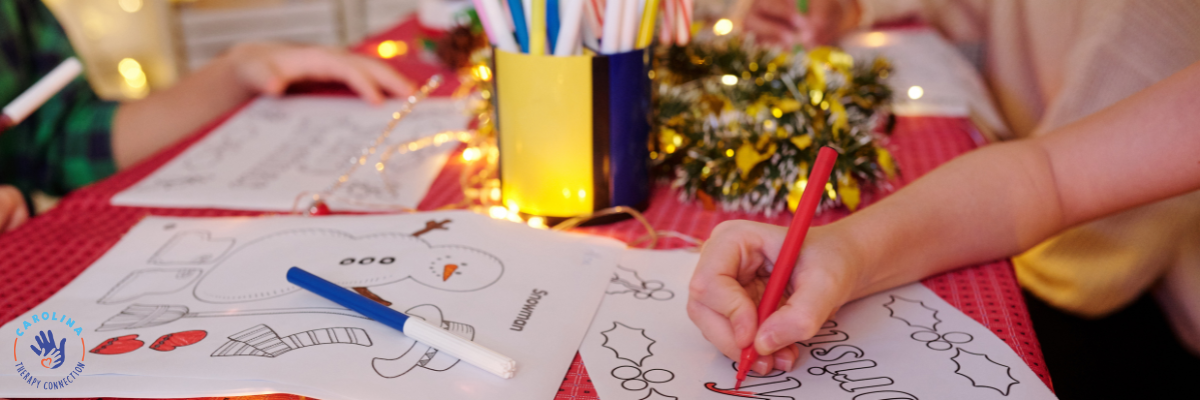
So this season, ditch the writing worksheets and try these 5 fun, low-prep holiday OT activities you can do at home to help improve handwriting skills — without the frustration! Here are your holiday fine motor activities for kids:

1. Tear & Rip Gingerbread Art 

A great activity for strengthening the small hand muscles responsible for a mature tripod grasp.

How to Do It:

  • Tear thick construction paper into tiny pieces
  • Glue onto a gingerbread template to decorate

Skills Worked On:
Intrinsic hand strength • graded pressure • visual-motor integration • pre-writing foundation

Supplies:

  • Construction paper
  • Glue
  • Gingerbread template (you can find this online, or just draw one yourself!)

2. Snowball Rescue 

This is a fan-favorite OT task for improving grasp strength and precision!

How to Do It:

  • Spread cotton balls or pom poms on a table
  • Use tongs or clothespins to sort by color, size, or number

Skills Worked On:
Pincer grasp • bilateral coordination • hand strength • counting & classification

Supplies:

  • Cotton balls or pom poms
  • Tongs or clothespins

3. Candy Cane Bead Ornament 

Threading beads builds dexterity, handwriting endurance, and refined grasp patterns.

How to Do It:

  • Alternate white and red beads on a pipe cleaner
  • Bend like a candy cane and hang it as a keepsake

Skills Worked On:
Finger isolation • tripod grasp strengthening • sequencing • bilateral coordination

Supplies:

  • Pipe cleaner
  • Red and white beads

4. Holiday Sticker Collage 

Peeling stickers strengthens the same muscles used to manipulate a pencil with control.

How to Do It:

  • Peel stickers
  • Place onto paper to create a festive collage

Skills Worked On:
Fine motor precision • visual scanning • creativity

Supplies:

  • Holiday-themed stickers
  • Blank paper

5. Q-Tip Painting: Dot Art 

Similar to writing, Q-tip art builds strength and motor control — but in a much more engaging way!

How to Do It:

  • Print or draw a simple holiday picture
  • Dip Q-tips in paint and stamp along the lines

Skills Worked On:
Finger control • attention to boundaries • visual-motor accuracy

Supplies:

  • Q-tips
  • Paper
  • Washable paint

Why These Holiday Activities Help With Pencil Grip

These simple OT-inspired activities support the building blocks of handwriting, including:

✨ Hand strength
✨ Bilateral coordination
✨ Finger dexterity
✨ Wrist stability
✨ Fine motor control

When these skills improve, children naturally shift toward a functional pencil grasp — without pressure, arguments, or discomfort.

Frequently Asked Questions

1. Why does my child struggle with pencil grasp?

Children may struggle due to weak fine motor muscles, delayed motor development, sensory challenges, low hand endurance, or skipped developmental milestones such as crawling or play-based strengthening.


2. What type of pencil grasp is considered age-appropriate?

A mature tripod grasp typically develops between ages 5–7, but progress varies. Before this stage, transitional grasps (like a modified tripod) are developmentally normal.


3. How can I help my child without constant reminders?

Use activities like the ones above to build strength and coordination before writing. Corrective reminders work better when the hand is strong and ready.


4. When should I seek occupational therapy?

If your child avoids writing, tires quickly, becomes frustrated, or has ongoing difficulty with grasp or handwriting, OT can help support development and confidence.

We’re Here to Help!

If handwriting, fine motor skills, or pencil grasp are challenging for your child, our licensed occupational therapists would love to support you.

Serving families in:
Greenville • New Bern • Goldsboro • Morehead City

Click here to request an evaluation or learn more about OT services.

Why Decorating Christmas Cookies Is the BEST Fine Motor OT Activity (Backed by Occupational Therapists!)

Written by: Qiana Jones, COTA/L | Carolina Therapy Connection

Looking for a fun, seasonal way to build your child’s fine motor skills at home?
Grab the frosting and sprinkles — because decorating Christmas cookies is secretly one of the BEST OT-approved activities for little hands! 🙌✨

Not only is it festive and motivating, but it naturally targets so many foundational developmental skills. The best part? Kids don’t even realize they’re working… they’re simply having fun.

Here’s why this sweet holiday activity delivers BIG benefits for growing bodies and brains.  (Everything below comes straight from OT principles and developmental milestones!)


1. Builds Hand Strength

Squeezing icing tubes, pressing cookie cutters, rolling dough, and adding toppings all strengthen the small hand muscles needed for:

  • handwriting
  • buttoning
  • opening containers
  • gripping utensils

Your child is building functional strength while creating something delicious.

2. Improves Precision & Hand–Eye Coordination

Decorating requires focus and careful control.
Each drizzle of icing, each sprinkle placed, and each shape traced helps support:

  • refined finger movements
  • controlled wrist motion
  • improved accuracy
  • visual–motor integration

It’s the perfect blend of art + therapy.

3. Boosts Bilateral Coordination

Kids must use both hands together — one to hold the cookie and the other to decorate.
This strengthens the ability to coordinate both sides of the body, a huge skill for:

  • cutting with scissors
  • tying shoes
  • coloring
  • zipping and buttoning

Cookie decorating is bilateral coordination at its best!

4. Supports Emotional Regulation

The smells, textures, predictable steps, and creativity make this activity naturally calming.
It helps children:

  • improve focus
  • follow multi-step directions
  • stay regulated
  • enjoy a sensory-rich, positive experience

Holiday baking becomes a beautiful opportunity for connection and emotional growth.

5. Strengthens Visual–Motor & Pre-Writing Skills

Decorating shapes like:

  • lines
  • circles
  • zigzags
  • dots
  • curves

…mirrors the very strokes children need for handwriting.  It’s literally pre-writing without the paper.

6. Builds Independence & Confidence

Kids love seeing their designs come to life — and that feeling of success matters.

Cookie decorating supports:

  • task initiation
  • sequencing
  • independence
  • pride in creative work

Nothing lights up a child’s face quite like showing off their decorated cookie.

7. Bonus: Sensory Play That Kids Actually Enjoy

Cookie decorating offers sensory input that is:

  • sticky
  • crunchy
  • warm
  • colorful
  • tactile
  • olfactory-rich

It’s one of the rare activities where sensory exploration feels safe and exciting for even the most hesitant kiddos.

8. Encourages Kids Into the Kitchen (Huge for Picky Eaters!)

Getting kids involved in cookie decorating brings them into the kitchen in a fun, low-pressure way — which is BIG for supporting picky eaters. When children explore food through touching, smelling, mixing, and decorating, they build positive sensory experiences around new textures and smells.

This kind of gentle exposure helps reduce anxiety around food, boosts confidence, and opens the door for trying new things over time. Cooking together is one of the BEST ways to build comfort, curiosity, and connection around eating — all while creating sweet holiday memories.

Here’s what we think…

So, next time you bake with your child, remember — you’re not just making cookies.
You’re building fine motor skills, sensory awareness, visual–motor skills, emotional regulation, independence, and confidence… one sprinkle at a time. 💛✨

Our therapists also created this as a printable handout you can use at home or share with family and friends:

Download the Cookie OT Activity Here!

Bonus: Easy Sugar Cookie Recipe

Want to try this at home? Here’s a simple, parent-friendly recipe included in the PDF:

Ingredients:

  • 1 cup unsalted butter, softened
  • 1 cup sugar
  • 1 egg
  • 1 teaspoon vanilla
  • ½ teaspoon salt
  • 2 ½ cups sifted flour

Directions:
Cream together butter and sugar. Beat in the egg.
Add remaining ingredients and mix until well-blended.
Chill dough 3–4 hours. Preheat oven to 350°F.
Roll out dough on a lightly floured counter to ¼” thick.
Cut with cookie cutters.
Bake on parchment-lined sheets for 8–10 minutes or until lightly colored.
Let cool + decorate with icing.
Makes 16–24 cookies.

Holiday Overload: 7 Therapist-Backed Tips to Keep Your Child Regulated This Season

The holiday season is full of joy, celebration, and family time — but for many kids, it can also be a season of overwhelm. Bigger crowds, louder settings, disrupted routines, travel, new foods, and lots of excitement can quickly lead to dysregulation, meltdowns, and stress.

And let’s be honest… It’s not just kids who feel it. The whole family feels it.

Our therapy team at Carolina Therapy Connection put together this helpful guide to support children (and parents!) in staying calm, connected, and regulated this holiday season.

These strategies come straight from our OT, PT, Speech, and Mental Wellness clinicians who help families navigate sensory overload, transitions, and big emotions every day.

1. Prep Your Child Before Events (Predictability = Peace)

Kids regulate best when they know what to expect.
Before you leave the house, try sharing:

  • Where are you going
  • Who will be there
  • How long you will stay
  • What activities will happen
  • What food will be served
  • What the expectations are

Consider showing pictures or using simple visuals for younger children. Social stories also come in handy! A few minutes of preparation can prevent an hour of overwhelm later.

2. Build in Sensory Breaks — Before They’re Needed

Holiday gatherings are full of bright lights, noises, smells, and excitement.
Plan “regulation moments” throughout the day:

  • A walk outside
  • Quiet room breaks
  • Heavy work activities (push/pull/lift)
  • Deep pressure squeezes
  • Vibration plate time before you leave (Galileo!)
  • Chewy snacks or crunchy foods
  • Noise-reducing headphones

Think of these as “prevention breaks” instead of “meltdown rescue missions.” Engaging in deep pressure and heavy work activities before you leave is a great way to prepare! 

3. Create a Safe Space at Home and When Traveling

Whether you’re visiting family or hosting, identify a calm corner or sensory safe space where your child can reset.

You can include:

  • A soft blanket
  • Books
  • Fidgets
  • A calming visual timer
  • Headphones
  • A small weighted item

Let your child know they can go there anytime they need a break — no shame, no punishment. 

4. Keep Nourishment & Sleep on Track (As Much as Possible)

Hunger and tiredness are the hidden triggers behind many holiday meltdowns.

Try to maintain:

  • Regular mealtimes
  • Snacks on hand
  • Earlier wind-down routines
  • Familiar sleep cues
  • Comfort objects

Even slight consistency can help the brain stay regulated.

5. Support Picky Eaters Without Pressure

Holiday meals can be overwhelming for kids with sensory or feeding challenges.
Try this:

  • Offer one safe food you know they’ll eat
  • Let them explore or smell new foods without expectations
  • Serve food “family style” so they can control what’s on their plate
  • Avoid “just try one bite” pressure
  • Model enjoying the food yourself

Positive exposure now leads to expanded eating later.

6. Give Choices to Reduce Anxiety & Build Independence

When kids feel overwhelmed, they often feel out of control.
Offer choices like:

  • “Do you want to sit at the kids’ table or the couch?”
  • “Do you want to stay 30 more minutes or 15?”
  • “Do you want to bring your backpack or your fidget bag?”

This promotes buy-in and lowers power struggles.

7. Remember: Connection Regulates More Than Anything

Your presence is your child’s anchor.
When things feel “too big,” your calm becomes their calm.

Try:

  • Getting to eye level
  • Using a soft voice
  • Offering a hug
  • Naming their feelings
  • Taking deep breaths together

Kids don’t need a perfect holiday — they need a connected one!

Our therapists created a FREE resource to help your family stay calm and regulated during the holiday season. Download it below!

Download the Holiday Checklist

Final Thoughts

At CTC, we believe every child deserves to enjoy the magic of the holidays. With the right tools, support, and strategies, families can create joyful moments that feel peaceful, regulated, and full of connection.

If your child struggles with sensory overload, emotional regulation, feeding challenges, motor delays, or communication needs, our team is here to help!

All CTC clinics currently have NO WAITLIST — Occupational Therapy, Physical Therapy, Speech Language Therapy, Feeding, Mental Wellness Counseling, Tutoring.

You can request an appointment anytime!

Picky Eating or Something More? Signs Your Child Needs Feeding Support

Does your child avoid certain foods, gag at new textures, or flat-out refuse entire food groups? Mealtimes shouldn’t feel like a battle, but for parents of picky eaters, it can be one of the most stressful parts of the day. Pediatric occupational therapy can help transform mealtime from a struggle into a positive experience by addressing the root cause of your child’s food aversions.

What Is a Picky Eater?

Picky eating is more than just being “a little particular.” It can include avoiding specific textures, colors, smells, or temperatures of foods, often resulting in a restricted diet. While some pickiness is typical during development, extreme food avoidance or distress around eating may signal an underlying sensory or developmental challenge.

Children may be labeled “picky” when they:

  • Eat fewer than 20 foods
  • Refuse entire food groups (like fruits or vegetables)
  • Struggle with food textures or strong smells
  • Experience anxiety or meltdowns at mealtimes
  • Have difficulty chewing or swallowing certain foods

Why Occupational Therapy for Picky Eaters?

Pediatric occupational therapists (OTs) are trained to look beyond eating behaviors and uncover the “why” behind picky eating. Often, it’s tied to sensory processing difficulties, oral motor challenges, or poor postural control that makes eating physically uncomfortable.

Sensory Processing and Feeding

Children who are sensitive to textures, smells, or temperatures may experience a sensory overload when introduced to new foods. For example, a soft banana might feel “mushy” and unpleasant, or the smell of broccoli might feel overwhelming.

OTs help children explore these sensitivities in a supportive environment through sensory integration therapy. They work to slowly and safely desensitize kids to new sensations so that food becomes less threatening.

Oral Motor and Postural Skills

Eating also requires strong oral motor and postural control. Children with weak jaw muscles, poor tongue coordination, or low muscle tone may find chewing difficult or exhausting, which can make food less enjoyable. OTs support these underlying motor skills to help children feel more confident and capable during meals.

Red Flags That May Indicate a Need for Help

If your child’s picky eating is affecting growth, nutrition, or daily routines, it might be time to speak with a professional. Some red flags include:

  • Difficulty transitioning to solid foods
  • Coughing, gagging, or vomiting during meals
  • Eating the same foods every day without variation
  • Poor weight gain or slow growth
  • Avoiding social situations involving food

Strategies OTs Use with Picky Eaters

Occupational therapy doesn’t just take place at the clinic—it empowers families with practical strategies to use at home. Here are a few common approaches used by OTs:

  • Food Chaining: This method helps children transition from preferred foods to new foods by making small, manageable changes. For example, moving from plain crackers to whole wheat crackers, then to toasted bread.
  • Play-Based Exposure: Children explore new foods through play and sensory activities—touching, smelling, and eventually tasting foods at their own pace. Removing pressure and expectations allows kids to feel safe and curious.
  • Positive Mealtime Routines: Therapists help families create consistent routines and eliminate everyday power struggles during meals. This might include visual schedules, timer-based meal times, or family-style dining to model good behavior.
  • Environmental Modifications: Simple changes, such as adjusting seating posture, minimizing distractions, or using adaptive utensils, can make a significant difference in a child’s willingness to participate in meals.

How Carolina Therapy Connection Can Help

At Carolina Therapy Connection, we understand how frustrating and emotional it can be to raise a child who struggles with eating. Our pediatric occupational therapists specialize in identifying the underlying causes of picky eating and providing customized strategies that make a real difference.

Whether your child needs support with sensory processing, oral motor skills, or building positive routines, we are here to help. We offer free screenings to determine if your child would benefit from therapy, and we can schedule a comprehensive feeding evaluation to get started. Let us help turn mealtime into a time of connection, not conflict.

Building Strength from the Start: The Benefits of Tummy Time for Babies

Have you ever heard of tummy time? If you have a baby or know someone with one, you might have! Tummy time is when your baby spends time lying on their belly while they’re awake and supervised. It might not seem like a big deal, but it’s super essential for your baby’s growth and development!

What Is Tummy Time?

Tummy time is simple: place your baby on their belly while they’re awake and keep a close eye on them. This helps strengthen their neck, shoulders, and back muscles, allowing them to grow strong and achieve significant milestones, such as rolling over, sitting up, and crawling.

Why Is Tummy Time Important? Babies spend a lot of time on their backs when they sleep, which is great for safety! But if they don’t get enough time on their tummies while awake, their muscles might not develop as well. 

Tummy time helps:

  • Strengthen muscles – It builds the muscles needed for activities such as sitting, crawling, and walking.
  • Prevent flat spots on the head – Babies’ heads are soft, and spending too much time on their backs can increase pressure on the back of the head, ultimately causing flattening.
  • Improve motor skills – Tummy time gets babies ready for significant movements like rolling and reaching.
  • Support visual development – Looking around from a new angle helps babies learn and explore!

How to Make Tummy Time Fun

Tummy time isn’t always a favorite at first, but don’t worry! There are ways to make it fun for your baby:

  • Use toys – Place colorful, high-contrast, or noisy toys in front of them to encourage reaching and exploring their surroundings.
  • Get on their level – Lie on the floor with your baby so they can see your face and hear your voice.
  • Try different surfaces – A soft blanket, tummy time mat, or even your chest can make it more comfortable.
  • Make it short but frequent – Start with a few minutes a couple of times a day and work up to longer sessions.

When Should You Start Tummy Time?

You can start tummy time as soon as your baby is born! Even newborns can spend a little time on their bellies each day. By around 3 to 4 months old, babies should aim for about an hour of tummy time spread throughout the day.

Need Help? Carolina Therapy Connection has you covered! 

If your baby doesn’t enjoy tummy time or has trouble lifting their head, our pediatric physical therapy team is here to help! We can give you fun tips and exercises to make your little one’s tummy time easier and more enjoyable.

Tummy time is a small activity with enormous benefits! Give it a try, have fun, and watch your baby grow stronger every day!