



Contact Us Make a payment Check In

Concussions in Children: What Parents Should Know

Children of all ages can experience concussions, even during everyday play. Knowing what to look for and how to support recovery can help your child heal safely and confidently.

What Is a Concussion?

A concussion is a mild injury to the brain that can occur when a child hits their head or experiences a sudden movement that causes the brain to shift inside the skull. While concussions often happen after a direct hit to the head, they can also occur during falls, car accidents, or sports activities when the body stops or changes direction quickly.

Common Concussion Symptoms in Children

Concussion symptoms can vary from child to child and may appear immediately or hours later. Some common signs include:

  • Headaches
  • Nausea or vomiting
  • Dizziness or balance difficulties
  • Sensitivity to light or noise
  • Changes in sleep (sleeping more or less than usual)
  • Difficulty concentrating or keeping up at school
  • Increased irritability or emotional changes

For babies and toddlers, watch for:

  • Decreased interest in play
  • Eating less than usual
  • Changes in bathroom habits
  • Increased crying, frustration, or clinginess

What to Do If You Suspect a Concussion

If you think your child may have a concussion, seek medical care as soon as possible. A healthcare provider can evaluate your child and determine the next steps for care. While imaging tests may be used in some cases, many concussions do not require them.

Early medical guidance helps protect your child’s brain and supports a safer recovery.

Supporting Recovery at Home

Once your child returns home, the brain needs time to rest and heal. The first 24–48 hours play a critical role in recovery.

During this time:

  • Limit screen use (TVs, phones, tablets)
  • Avoid physical activity
  • Encourage quiet, low-stimulation activities
  • Allow rest and sleep as needed

If symptoms increase, reduce stimulation further and consult your child’s provider.

Returning to School and Activities

After the initial rest period, your child can gradually return to daily activities based on how they feel. Recovery should always move at your child’s pace.

Some children may need:

  • Shortened school days
  • Extra breaks
  • Reduced homework or screen time

Sports and active play should only resume with medical guidance. If symptoms return, activity levels should decrease.

When Symptoms Last Longer Than Expected

Most children begin to feel better within one to three months, but every child heals differently. If symptoms persist, such as headaches, dizziness, balance problems, or discomfort with movement, physical therapy may HELP!

How Physical Therapy Supports Concussion Recovery

Physical therapy plays an important role in concussion recovery, especially when symptoms linger. A physical therapist evaluates how your child moves, balances, and responds to motion. This may include checking posture, eye movements, walking patterns, and coordination.

Based on these findings, the therapist creates a personalized plan that supports safe healing.

Physical therapy can help by:

  • Improving balance and coordination
  • Reducing dizziness and motion sensitivity
  • Supporting safe return to daily movement and sports
  • Building confidence during recovery

Therapists guide children through a gradual return-to-activity process, adjusting the plan if symptoms reappear.

Education and Ongoing Support

Physical therapists also teach families how to manage symptoms at home, recognize signs of overexertion, and understand when rest or activity is appropriate. They often collaborate with doctors and schools to support a safe return to learning and play.

When Is Physical Therapy Complete?

Your child may finish physical therapy when they:

  • Experience no symptoms during rest or activity
  • Participate fully in school, play, and sports
  • No longer need accommodations or restrictions

With the right care, patience, and support, most children fully recover and return to the activities they enjoy.

How Can Carolina Therapy Connection Help?

At CTC, we help children recover from concussions through personalized physical therapy programs designed to restore balance, coordination, and confidence. Our licensed therapists support children throughout recovery and guide families every step of the way.

If you have concerns about your child’s recovery or ongoing symptoms after a concussion, we’re here to help!

👉 Visit our website to learn more or schedule an evaluation today.

Feeding Tube Awareness: Inclusive Mealtimes for Children

Written by: Qiana Jones, COTA/L 

Feeding Tube Awareness Week offers an opportunity to raise understanding, reduce stigma, and celebrate children who receive nutrition through feeding tubes. At Carolina Therapy Connection, we believe feeding is about more than intake… It’s about connection, participation, dignity, and honoring each child’s unique needs.

From an occupational therapy perspective, the use of feeding tubes does not represent a failure. They serve as supportive medical tools that help children grow, conserve energy, and engage more fully in daily life.

Understanding Tube Feeding Through an Occupational Therapy Lens

Children may require feeding tubes for many reasons, including:

  • Medical complexity
  • Sensory processing differences
  • Oral-motor or swallowing challenges
  • Difficulty regulating during mealtimes

Tube feeding can:

  • Support adequate nutrition and hydration
  • Reduce stress and pressure around eating
  • Allow children to focus energy on play, learning, and development

Some tube-fed children also eat by mouth, while others do not, and both experiences are VALID. As occupational therapists, we focus on safety, regulation, and meaningful participation, rather than forcing a single feeding outcome.

Creating Inclusive Mealtimes at Home

Family meals can remain meaningful and inclusive, even when the way we feed looks different.

🍽️ Togetherness Matters More Than Sameness

Children do not need to eat the same way to belong at the table. Sitting together, participating in routines, and sharing conversation reinforces connection and a sense of belonging.

🧃 Normalize Tube Feeding Within Daily Routines

When appropriate, families can include tube feeds during shared mealtimes rather than separating them. This approach helps normalize tube feeding and reduces feelings of difference or isolation.

Having Healthy Conversations About Tube Feeding

How adults talk about tube feeding shapes how children understand their bodies and needs.

💬 Use Neutral, Confident Language

Supportive phrases may include:

  • “This is how your body gets the nutrition it needs.”
  • “Everyone’s body works differently.”

Avoid language that frames tube feeding as something to “fix” or apologize for.

🌱 Welcome Curiosity

Siblings, peers, and adults often have questions. Simple, factual responses help normalize tube feeding and reduce stigma:

  • “This helps their body grow strong.”

Feeding Is About More Than Food

From an occupational therapy perspective, feeding involves more than eating. It includes:

  • Sensory processing
  • Motor coordination
  • Emotional regulation
  • Past experiences
  • Feelings of safety and trust

For some children, oral feeding feels overwhelming—or may not be safe. Tube feeding allows the nervous system to regulate, so exploration, if and when appropriate, can happen without pressure.

Progress may look like:

  • Reduced anxiety at meals
  • Increased tolerance of food-related experiences
  • Longer participation at the table
  • Improved family routines

These gains matter, and they deserve recognition and celebration.

Supporting Families With Compassion

Families of tube-fed children often navigate:

  • Emotional stress
  • Conflicting advice
  • Social pressure
  • Fear of judgment

Choosing tube feeding reflects care, advocacy, and responsiveness to a child’s needs, NOT a lack of effort. Families deserve support grounded in empathy and respect.

How Can Carolina Therapy Connection Help?

Our occupational therapy team supports:

  • Inclusive, child-centered mealtime routines
  • Individual feeding journeys without judgment
  • Family partnership grounded in compassion
  • Dignity, understanding, and meaningful participation

Feeding tubes help children THRIVE… not just survive.
If you have questions about feeding, regulation, or participation at mealtimes, our occupational therapy team is here to help.

Schedule your free consultation by clicking here.

Is My Baby Talking Late? A Parent’s Guide to Early Speech & Language Milestones (Birth–3 Years)

Written by: Alexis Bullock, CF-SLP | Carolina Therapy Connection

Every baby develops at their own pace, especially when it comes to communication. Still, it’s natural for parents to wonder whether their little one is on track—or if it might be time to seek support. Understanding early speech and language milestones can make a big difference in catching concerns early and getting the right help when it matters most. 

If you’ve ever wondered…

  • “Should my toddler be saying more words by now?”
  • “Why isn’t my baby babbling yet?”
  • “Is this normal… or is it something I should check on?”

…you are not alone.
Many parents worry about whether their child’s communication is developing as expected — and with so much mixed information online, it can be overwhelming to know when to seek help.

Here’s the good news:
Babies and toddlers learn language through everyday interactions — playing, watching, listening, and connecting with the people around them. Early intervention can make a big difference if communication delays are present, and getting answers sooner helps reduce worry and set your child up for success!

This guide will walk you through:

  • ✔ Expected speech and language milestones
  • ✔ Signs your child may need speech therapy
  • ✔ How early intervention can help
  • ✔ Simple ways to support communication at home
  • ✔ Where to get help in Greenville, New Bern, Goldsboro, and Morehead City, NC

What’s “Normal” Speech Development?

Every child develops differently, but guidelines from the American Speech-Language-Hearing Association (ASHA) help us understand typical communication milestones. These ranges are approximate, but helpful for spotting patterns.

Birth to 3 Months

  • Responds to sounds in their environment
  • Turns toward noises
  • Coos with single vowel sounds (ex: “ooo,” “aaa”)
  • Makes different cries depending on needs (hungry, tired, uncomfortable)

4–6 Months

  • Laughs and giggles
  • Watches caregivers’ faces
  • Vocalizes when playing
  • Combines vowel sounds (ex: “ah-oo”)
  • May blow raspberries

7–9 Months

  • Looks when name is called
  • Babbles strings of sounds (ex: “bababa,” “mamama”)
  • Shows affection and seeks comfort
  • Responds to “no” or pauses in routine

10–12 Months

  • Waves, points, claps
  • Imitates sounds and gestures
  • Responds to simple routine phrases (ex: “bye-bye,” “look”)
  • Says 1–2 first words (ex: mama, dada, ball)

13–18 Months

  • Follows simple 1-step directions (“come here,” “give me”)
  • Uses gestures to make requests
  • Uses at least 10–20 meaningful words
  • Identifies familiar people and objects
  • Imitates sounds and actions

19–24 Months

  • Uses and understands at least 50 words
  • Combines two words (ex: “more milk,” “mommy help”)
  • Follows 2-step directions
  • Begins using pronouns (me, mine, you)

2–3 Years

  • Talks in short phrases or early sentences
  • Asks “what,” “where,” or “why”
  • Uses plurals and early grammar forms (-ing, -ed)
  • Speech becomes easier to understand
  • Correctly produces sounds like: p, b, m, h, w, d, n

🚩 Signs Your Child May Need Speech Therapy

If you notice one or more of the following, it may be time to get support:

  • ❌ No babbling by 6–7 months
  • ❌ Doesn’t respond to their name by 9 months
  • ❌ Fewer than 5–10 words by 15–18 months
  • ❌ Fewer than 50 words or no word combinations by 2 years
  • ❌ Hard to understand compared to same-age peers
  • ❌ Limited eye contact, gestures, or imitation
  • ❌ Frustration when trying to communicate
  • ❌ History of frequent ear infections

Parent tip: If you’re wondering whether to wait or start services, trust your gut — early support never hurts and often helps significantly.

How Early-Intervention Speech Therapy Helps

Speech therapy helps toddlers:

  • Build vocabulary
  • Improve speech clarity
  • Strengthen social communication
  • Reduce communication frustration
  • Support feeding, gestures, and language processing

Research shows that birth to 3 years is the most powerful window for developing speech and language because the brain is rapidly forming neural pathways.

Easy Ways to Support Language at Home

Try these simple routines throughout your day:

  1. Respond to all communication attempts (pointing, babbles, gestures)
  2. Expand what they say → “Dog!” → “Yes! A big brown dog!”
  3. Read daily — point to pictures and label objects
  4. Narrate routines → “We’re putting on shoes… one… two…”
  5. Ask open-ended questions instead of yes/no
  6. Reduce screen time and increase interaction
  7. Use songs, finger plays, and rhymes
  8. Pair words with gestures or signs
  9. Create opportunities to request (pause with snacks or toys)
  10. Wait and give time — silence encourages speech!

Don’t Forget About Hearing

Hearing is directly connected to speech development. If you have any concerns or if your child has chronic ear infections, check with your pediatrician or schedule a hearing screening.

📞 Ready for Help? We’re Here For You!

If something doesn’t feel right — you’re not being “dramatic,” you’re being a great parent.

Carolina Therapy Connection offers play-based, research-backed speech therapy for infants and toddlers in:

📍 Greenville
📍 Goldsboro
📍 New Bern
📍 Morehead City

👉 Click here to request a free consultation or evaluation.

Early support builds confidence, connection, and communication — and we’re honored to walk this journey with your family!

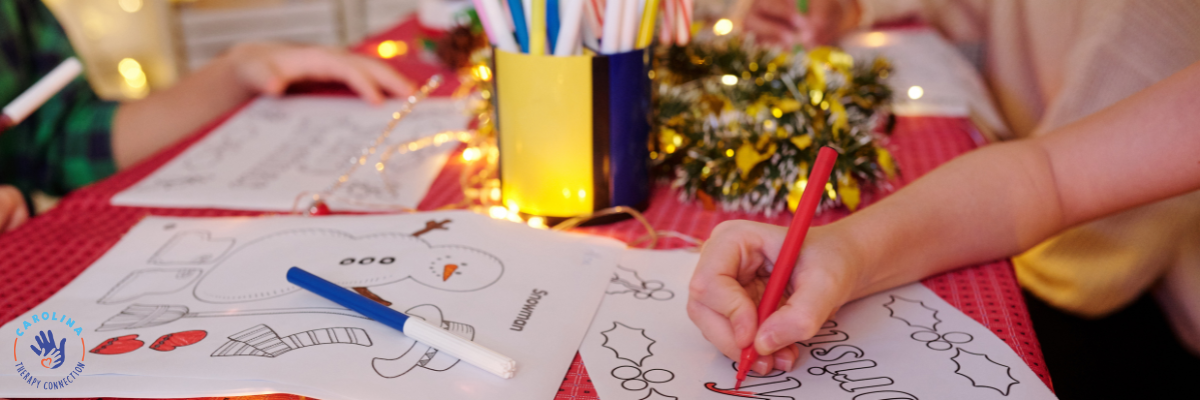
Struggling With Pencil Grip? Try These 5 Holiday OT Activities Instead! 

Written by Samaria Lawson, COTA/L

Does your child struggle to use an age-appropriate pencil grasp when writing, coloring, or completing school tasks? Maybe they hold their pencil in a fist, wrap extra fingers around it, switch hands frequently, or get frustrated and avoid writing altogether.

You’re not alone — and you don’t have to spend the holidays correcting pencil grip, repeating handwriting drills, or battling frustration.

Instead, occupational therapy research shows that a strong, functional pencil grasp develops through fine motor strengthening, finger isolation, dexterity, grasp development, and bilateral coordination — and the best way to build those skills is through play

So this season, ditch the writing worksheets and try these 5 fun, low-prep holiday OT activities you can do at home to help improve handwriting skills — without the frustration! Here are your holiday fine motor activities for kids:

1. Tear & Rip Gingerbread Art 

A great activity for strengthening the small hand muscles responsible for a mature tripod grasp.

How to Do It:

  • Tear thick construction paper into tiny pieces
  • Glue onto a gingerbread template to decorate

Skills Worked On:
Intrinsic hand strength • graded pressure • visual-motor integration • pre-writing foundation

Supplies:

  • Construction paper
  • Glue
  • Gingerbread template (you can find this online, or just draw one yourself!)

2. Snowball Rescue 

This is a fan-favorite OT task for improving grasp strength and precision!

How to Do It:

  • Spread cotton balls or pom poms on a table
  • Use tongs or clothespins to sort by color, size, or number

Skills Worked On:
Pincer grasp • bilateral coordination • hand strength • counting & classification

Supplies:

  • Cotton balls or pom poms
  • Tongs or clothespins

3. Candy Cane Bead Ornament 

Threading beads builds dexterity, handwriting endurance, and refined grasp patterns.

How to Do It:

  • Alternate white and red beads on a pipe cleaner
  • Bend like a candy cane and hang it as a keepsake

Skills Worked On:
Finger isolation • tripod grasp strengthening • sequencing • bilateral coordination

Supplies:

  • Pipe cleaner
  • Red and white beads

4. Holiday Sticker Collage 

Peeling stickers strengthens the same muscles used to manipulate a pencil with control.

How to Do It:

  • Peel stickers
  • Place onto paper to create a festive collage

Skills Worked On:
Fine motor precision • visual scanning • creativity

Supplies:

  • Holiday-themed stickers
  • Blank paper

5. Q-Tip Painting: Dot Art 

Similar to writing, Q-tip art builds strength and motor control — but in a much more engaging way!

How to Do It:

  • Print or draw a simple holiday picture
  • Dip Q-tips in paint and stamp along the lines

Skills Worked On:
Finger control • attention to boundaries • visual-motor accuracy

Supplies:

  • Q-tips
  • Paper
  • Washable paint

Why These Holiday Activities Help With Pencil Grip

These simple OT-inspired activities support the building blocks of handwriting, including:

✨ Hand strength
✨ Bilateral coordination
✨ Finger dexterity
✨ Wrist stability
✨ Fine motor control

When these skills improve, children naturally shift toward a functional pencil grasp — without pressure, arguments, or discomfort.

Frequently Asked Questions

1. Why does my child struggle with pencil grasp?

Children may struggle due to weak fine motor muscles, delayed motor development, sensory challenges, low hand endurance, or skipped developmental milestones such as crawling or play-based strengthening.


2. What type of pencil grasp is considered age-appropriate?

A mature tripod grasp typically develops between ages 5–7, but progress varies. Before this stage, transitional grasps (like a modified tripod) are developmentally normal.


3. How can I help my child without constant reminders?

Use activities like the ones above to build strength and coordination before writing. Corrective reminders work better when the hand is strong and ready.


4. When should I seek occupational therapy?

If your child avoids writing, tires quickly, becomes frustrated, or has ongoing difficulty with grasp or handwriting, OT can help support development and confidence.

We’re Here to Help!

If handwriting, fine motor skills, or pencil grasp are challenging for your child, our licensed occupational therapists would love to support you.

Serving families in:
Greenville • New Bern • Goldsboro • Morehead City

Click here to request an evaluation or learn more about OT services.

Why Decorating Christmas Cookies Is the BEST Fine Motor OT Activity (Backed by Occupational Therapists!)

Written by: Qiana Jones, COTA/L | Carolina Therapy Connection

Looking for a fun, seasonal way to build your child’s fine motor skills at home?
Grab the frosting and sprinkles — because decorating Christmas cookies is secretly one of the BEST OT-approved activities for little hands! 🙌✨

Not only is it festive and motivating, but it naturally targets so many foundational developmental skills. The best part? Kids don’t even realize they’re working… they’re simply having fun.

Here’s why this sweet holiday activity delivers BIG benefits for growing bodies and brains.  (Everything below comes straight from OT principles and developmental milestones!)


1. Builds Hand Strength

Squeezing icing tubes, pressing cookie cutters, rolling dough, and adding toppings all strengthen the small hand muscles needed for:

  • handwriting
  • buttoning
  • opening containers
  • gripping utensils

Your child is building functional strength while creating something delicious.

2. Improves Precision & Hand–Eye Coordination

Decorating requires focus and careful control.
Each drizzle of icing, each sprinkle placed, and each shape traced helps support:

  • refined finger movements
  • controlled wrist motion
  • improved accuracy
  • visual–motor integration

It’s the perfect blend of art + therapy.

3. Boosts Bilateral Coordination

Kids must use both hands together — one to hold the cookie and the other to decorate.
This strengthens the ability to coordinate both sides of the body, a huge skill for:

  • cutting with scissors
  • tying shoes
  • coloring
  • zipping and buttoning

Cookie decorating is bilateral coordination at its best!

4. Supports Emotional Regulation

The smells, textures, predictable steps, and creativity make this activity naturally calming.
It helps children:

  • improve focus
  • follow multi-step directions
  • stay regulated
  • enjoy a sensory-rich, positive experience

Holiday baking becomes a beautiful opportunity for connection and emotional growth.

5. Strengthens Visual–Motor & Pre-Writing Skills

Decorating shapes like:

  • lines
  • circles
  • zigzags
  • dots
  • curves

…mirrors the very strokes children need for handwriting.  It’s literally pre-writing without the paper.

6. Builds Independence & Confidence

Kids love seeing their designs come to life — and that feeling of success matters.

Cookie decorating supports:

  • task initiation
  • sequencing
  • independence
  • pride in creative work

Nothing lights up a child’s face quite like showing off their decorated cookie.

7. Bonus: Sensory Play That Kids Actually Enjoy

Cookie decorating offers sensory input that is:

  • sticky
  • crunchy
  • warm
  • colorful
  • tactile
  • olfactory-rich

It’s one of the rare activities where sensory exploration feels safe and exciting for even the most hesitant kiddos.

8. Encourages Kids Into the Kitchen (Huge for Picky Eaters!)

Getting kids involved in cookie decorating brings them into the kitchen in a fun, low-pressure way — which is BIG for supporting picky eaters. When children explore food through touching, smelling, mixing, and decorating, they build positive sensory experiences around new textures and smells.

This kind of gentle exposure helps reduce anxiety around food, boosts confidence, and opens the door for trying new things over time. Cooking together is one of the BEST ways to build comfort, curiosity, and connection around eating — all while creating sweet holiday memories.

Here’s what we think…

So, next time you bake with your child, remember — you’re not just making cookies.
You’re building fine motor skills, sensory awareness, visual–motor skills, emotional regulation, independence, and confidence… one sprinkle at a time. 💛✨

Our therapists also created this as a printable handout you can use at home or share with family and friends:

Download the Cookie OT Activity Here!

Bonus: Easy Sugar Cookie Recipe

Want to try this at home? Here’s a simple, parent-friendly recipe included in the PDF:

Ingredients:

  • 1 cup unsalted butter, softened
  • 1 cup sugar
  • 1 egg
  • 1 teaspoon vanilla
  • ½ teaspoon salt
  • 2 ½ cups sifted flour

Directions:
Cream together butter and sugar. Beat in the egg.
Add remaining ingredients and mix until well-blended.
Chill dough 3–4 hours. Preheat oven to 350°F.
Roll out dough on a lightly floured counter to ¼” thick.
Cut with cookie cutters.
Bake on parchment-lined sheets for 8–10 minutes or until lightly colored.
Let cool + decorate with icing.
Makes 16–24 cookies.

Holiday Overload: 7 Therapist-Backed Tips to Keep Your Child Regulated This Season

The holiday season is full of joy, celebration, and family time — but for many kids, it can also be a season of overwhelm. Bigger crowds, louder settings, disrupted routines, travel, new foods, and lots of excitement can quickly lead to dysregulation, meltdowns, and stress.

And let’s be honest… It’s not just kids who feel it. The whole family feels it.

Our therapy team at Carolina Therapy Connection put together this helpful guide to support children (and parents!) in staying calm, connected, and regulated this holiday season.

These strategies come straight from our OT, PT, Speech, and Mental Wellness clinicians who help families navigate sensory overload, transitions, and big emotions every day.

1. Prep Your Child Before Events (Predictability = Peace)

Kids regulate best when they know what to expect.
Before you leave the house, try sharing:

  • Where are you going
  • Who will be there
  • How long you will stay
  • What activities will happen
  • What food will be served
  • What the expectations are

Consider showing pictures or using simple visuals for younger children. Social stories also come in handy! A few minutes of preparation can prevent an hour of overwhelm later.

2. Build in Sensory Breaks — Before They’re Needed

Holiday gatherings are full of bright lights, noises, smells, and excitement.
Plan “regulation moments” throughout the day:

  • A walk outside
  • Quiet room breaks
  • Heavy work activities (push/pull/lift)
  • Deep pressure squeezes
  • Vibration plate time before you leave (Galileo!)
  • Chewy snacks or crunchy foods
  • Noise-reducing headphones

Think of these as “prevention breaks” instead of “meltdown rescue missions.” Engaging in deep pressure and heavy work activities before you leave is a great way to prepare! 

3. Create a Safe Space at Home and When Traveling

Whether you’re visiting family or hosting, identify a calm corner or sensory safe space where your child can reset.

You can include:

  • A soft blanket
  • Books
  • Fidgets
  • A calming visual timer
  • Headphones
  • A small weighted item

Let your child know they can go there anytime they need a break — no shame, no punishment. 

4. Keep Nourishment & Sleep on Track (As Much as Possible)

Hunger and tiredness are the hidden triggers behind many holiday meltdowns.

Try to maintain:

  • Regular mealtimes
  • Snacks on hand
  • Earlier wind-down routines
  • Familiar sleep cues
  • Comfort objects

Even slight consistency can help the brain stay regulated.

5. Support Picky Eaters Without Pressure

Holiday meals can be overwhelming for kids with sensory or feeding challenges.
Try this:

  • Offer one safe food you know they’ll eat
  • Let them explore or smell new foods without expectations
  • Serve food “family style” so they can control what’s on their plate
  • Avoid “just try one bite” pressure
  • Model enjoying the food yourself

Positive exposure now leads to expanded eating later.

6. Give Choices to Reduce Anxiety & Build Independence

When kids feel overwhelmed, they often feel out of control.
Offer choices like:

  • “Do you want to sit at the kids’ table or the couch?”
  • “Do you want to stay 30 more minutes or 15?”
  • “Do you want to bring your backpack or your fidget bag?”

This promotes buy-in and lowers power struggles.

7. Remember: Connection Regulates More Than Anything

Your presence is your child’s anchor.
When things feel “too big,” your calm becomes their calm.

Try:

  • Getting to eye level
  • Using a soft voice
  • Offering a hug
  • Naming their feelings
  • Taking deep breaths together

Kids don’t need a perfect holiday — they need a connected one!

Our therapists created a FREE resource to help your family stay calm and regulated during the holiday season. Download it below!

Download the Holiday Checklist

Final Thoughts

At CTC, we believe every child deserves to enjoy the magic of the holidays. With the right tools, support, and strategies, families can create joyful moments that feel peaceful, regulated, and full of connection.

If your child struggles with sensory overload, emotional regulation, feeding challenges, motor delays, or communication needs, our team is here to help!

All CTC clinics currently have NO WAITLIST — Occupational Therapy, Physical Therapy, Speech Language Therapy, Feeding, Mental Wellness Counseling, Tutoring.

You can request an appointment anytime!

Hearing Loss in Children

About 2 to 3 out of every 1,000 children in the United States are born with a detectable level of hearing loss in one or both ears! Hearing loss can occur gradually over time and parents may not even realize their children have it. Children may simply adjust to the changes in their hearing and not realize they are missing out on important speech sounds and words. 

What is a hearing screening

Pediatric Audiology 101: Your Child's Hearing Health

A hearing screening is frequently used to check a person’s ability to detect the loudness and pitch of sounds. You can either “pass” or “fail” the screening. If your child passes and there are no other concerns, then you can continue with your child’s regularly scheduled hearing screenings. If your child “fails”, or if you have other concerns about their hearing, then an appointment for more in-depth testing may be necessary to see if there is a hearing loss and what treatment options are best to help support your child. These hearing screenings can help identify people who may need a more thorough hearing evaluation that can be completed by medical personnel such as ENTs or audiologists. Pediatric hearing screenings may take place in early intervention, school audiology, medical, and/or home settings. 

How can I tell if my child has hearing loss? 

  • Difficulty recognizing familiar voices
  • Delayed or absent speech sounds (not making cooing noises, babbling less, few words, distorted speech sounds, etc.)
  • Not turning head toward interesting or startling sounds
  • Delayed language (difficulty understanding simple words, following directions, etc.)
  • Delayed or absent emergence of first words as by two years old children should start combining words into 2-word phrases)
  • If child is older, they may frequently asks others to repeat themselves for clarification
  • Child is speaking louder than others
  • Lack of attention to others, conversations, environmental surroundings
  • Struggles with academics


What causes hearing loss in young children? 

  • Frequent ear infections (otitis media; most common)
  • Measles or meningitis
  • Head injuries
  • Exposure to loud noises 
  • Genetic disorders

Interesting Fact… 5/6 children experience ear infections (otitis media) by the time they are 3 years old!


What should I do if I suspect my child has hearing loss? 

If you suspect your child has hearing loss, speak with your healthcare provider and discuss your child’s current hearing abilities and address your concerns if you suspect signs of hearing difficulties at home. Early hearing detection and a formal evaluation completed by an audiologist, ENT and/or other qualified medical professional can help determine specific needs and appropriate treatment goals to further support your child’s success. It is important to regularly check on your child’s hearing health to monitor potential changes in hearing!


How can Speech therapy help?

Speech-Language Pathologists can play a role in your child’s hearing health by completing hearing screenings as a part of a formal speech and language assessment. If your child does not pass a hearing screening completed by the Speech-Language Pathologist, then a referral will be made for further evaluation with audiological/medical professionals to provide the best of care to your little one. Language acquisition is an essential component of your child’s overall development. Significant hearing loss, if undetected early, can lead to a speech and language delay, further putting your child at risk of falling behind same-aged peers. Given that our hearing plays a significant role in living our daily lives, it is crucial to have your child’s hearing formally evaluated at key milestones, beginning at birth to help lead them to better speech, language, and educational outcomes in the future!

Schedule a screening at Carolina Therapy Connection today!


Blog By: Lindsey Bryant, SLP

What are primitive reflexes?

A reflex is an automatic and instantaneous response to a sensory stimulus. Remember when you were a child at the doctor’s office and they tapped your knee with a small mallet to check if your leg kicked upwards? You didn’t decide to kick your leg, it just kicked. From infancy, reflexes are vitally important for proper development of the brain, nervous system, body and sensory systems. Some reflexes are meant to stay with us our whole lives. Others are designed to be dormant after their function is fulfilled – also called integration. Check out this awesome resource from Tools to Grow to learn more about specific reflexes and how they impact a child’s function during their daily life. Primitive reflexes are adaptive responses that develop before birth and typically integrate as the brain matures. Primitive reflexes are important for survival and development early in life; however, it is also important that they become integrated as the child grows. Retained reflexes can cause sensory issues, postural disorders, decreased motor skills, and attention/behavioral issues.

What causes retention of primitive reflexes?

Some potential causes of retention of primitive reflexes include c-sections, trauma during birth, exposure to toxins, decreased tummy time during infancy, decreased time crawling, chronic ear infections, or head injuries during infancy among many other unknown causes.

Five Commonly Retained Primitive Reflexes and their Impact on Occupations

1. Moro Reflex

The Moro Reflex is known as the “startle” reflex. This reflects is a fight or flight reaction. It is present at birth and should be integrated by four months. Common effects of retention include emotional outburst, motion sickness, and difficulties with vision, reading, and writing.

2. Asymmetric Tonic Neck Reflex (ATNR) 

The Asymmetric Tonic Neck Reflex (ATNR) is known as the “Fencer’s pose”. It assists in the birthing process. It appears at birth and should be integrated by nine months. Common effects of retention include decreased eye-hand coordination, poor handwriting, poor balance, difficulty with reading and math, and difficulty focusing.

3. Symmetric Tonic Neck Reflex (STNR) 

The Symmetric Tonic Neck Reflex (STNR) is an essential foundation for crawling. It appears at six to eight months and should be integrated by nine to eleven months. Common effects of retention include poor posture, W sitting position, poor eye-hand coordination, messy eater, and low muscle tone.

4. Tonic Labyrinthine Reflex (TLR) 

The Tonic Labyrinthine Reflex (TLR) is commonly seen in children with ADHD diagnoses. It appears before birth and should be integrated by three and a half years of age. Common effects of retention include decreased balance, poor spatial awareness, toe walking, weak muscles, poor posture, and difficulty with climbing.

5. Spinal Galant 

The Spinal Galant Reflex also assists in the birthing process. It appears at birth and should be integrated by three to nine months. Common effects of retention include bed wetting after potty training, hyperactivity, postural issues including scoliosis, attention issues, and decreased endurance.

What are integrated reflexes?

Integrated reflexes are important for developing motor control. A child needs motor control to maintain proper posture at a desk in school, ride a bike, read a book, cross midline, write, and get dressed. A child with integrated reflexes has normal movement patterns to complete these functional tasks at home and at school. A child with unintegrated reflexes could benefit from skilled reflex integration therapy which will essentially train a child’s brain by establishing an efficient movement pattern that supports higher level motor skills or cognitive tasks.

How do you know whether or not your child has integrated these reflexes?

There are many common areas of difficulty that may suggest a retained reflex including the following:

  • “Bouncing” Child: Constantly moving, can’t sit still on a chair, hyperactive
  • “Noodle” Child: Leans on everything, rests head on table
  • “Shirt Chewers”: Constantly chewing on shirts or pencils, and touches everything
  • “Emotional Child”: Challenges with regulating emotions, easily frustrated or upset, difficulty with utilizing age appropriate coping strategies to calm body
  • School Performance Challenges: difficulty with reading, handwriting, language/speech, poor sitting balance and immature grasp on writing utensils
  • Coordination Challenges: Chronic body aches, poor endurance, fatigue, muscle weakness, poor concentration, fidgeting, disorganization

How do I know If My Child Has Retained Primitive Reflexes and What Can I Do?

Once your Occupational Therapist suspects a retained reflex, he/she will educate the caregiver on the importance of carryover for treatment recommendations. Caregivers play an important role in seeing progression in their child’s everyday activities. It is typically recommended that the child completes a set of tailored exercises to meet your child’s needs, 5-10 minutes per day, for 30 consecutive days in order to see any progress. Your therapist may recommended a reward or sticker chart in order to keep your child motivated towards an end goal. Progress can be noted short term and over 9-12 months. In addition to exercises, your Occupational Therapist will make recommendations for modifications in the school and home environments which may include changing positioning during school work, movement breaks, sensory techniques, relaxation techniques, decreasing auditory and visual stimulation, and organizational skills, just to name a few!

In order to determine whether your child would benefit from direct treatment for Reflex Integration, it is recommended that your child be evaluated or screened by an Occupational Therapist at Carolina Therapy Connection. Give us a call at 252-341-9944 today to schedule your FREE occupational therapy screening with one of our experienced and knowledgable OT’s. 

What is AAC?

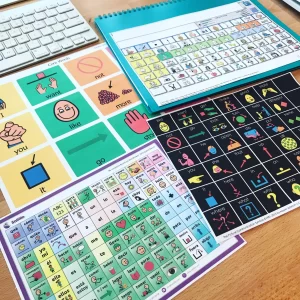
AAC stands for Augmentative and Alternative Communication. It encompasses all of the ways in which an individual may communicate outside of speaking verbally. Augmentative communication means to add to someone’s existing speech skills, and alternative means to be used in place of verbal speech. There are many different kinds of AAC including, but not limited to: gestures, facial expressions, writing, pictures symbols (e.g., picture exchange communication system/ PECS), drawing, sign language, high-tech speech generating devices, communication boards, etc. Some people may use one of these modalities, and some may use multiple modalities depending on the way in which they can most quickly and clearly communicate the topic.

Who Needs AAC?

Many different people use AAC throughout their lifetime. It can be used across the lifespan by any age, at any time, and for a variety of different reasons. Some people use AAC for their entire life, and some use it for only a short period of time. AAC can help any person who has difficulty fully or partially meeting their daily communication needs such as expressing wants and needs, socializing, asking questions, and a variety of other functions.


How can AAC help your child?

AAC may be able to help your child if they have difficulty being understood by others, have a limited vocabulary, demonstrate limited spontaneous speech, are non-speaking, and a variety of other different reasons. There are no prerequisite skills to your child beginning to use AAC. One common misconception is that AAC will hinder language development or cause your child to become dependent on it for communication. While some children may have minimal to no verbal speech throughout their lifetime, there is research to show that AAC can actually help children to develop language. Using AAC can also help to reduce frustration surrounding communication attempts, and help your child to communicate their needs more clearly, quickly, and effectively.


Parent’s Role in AAC

When introducing AAC to your child, it is important for family members/ caregivers to make the commitment to help the child succeed with the chosen AAC device. Your input is crucial in helping to choose and develop an appropriate AAC system, and using the device at home and in the community is a vital step to help both you and the child continue to learn the system. According to Jane Korsten, SLP, the average 18-month-old has been exposed to 4,380 hours of oral language at a rate of 8 hours/ day from birth. A child who has a communication system (AAC) and receives speech/language therapy 2 times/week for 20-30 minutes will reach the same amount of language exposure (in their AAC language) in 84 years. It is our role as professionals and caregivers to help minimize the communication gap between oral language users and AAC users. 

Modeling:  Modeling is an awesome way to both learn your child’s AAC system, and teach them an example of how they can use it. The best way to model is to speak and use the system at the same time, although you do not always have to select an icon for every word you say. For example, you may verbally say “time to go to school” while modeling “go” and “school” on the AAC system. A general rule of thumb is to model the number of icons your child is currently using, plus one. If your child uses 1 icon at a time, you may choose to model 1-2 icons at this time. It is important to model without expectation, meaning that you use the AAC system without expecting or requiring the child to respond, withholding items or activities, or “testing” their skills. The goal is to provide an example to the AAC learner, which they will then learn by watching and listening to what you do/say.


How can CTC help you and your child?

Whether your child is already receiving speech/language therapy services at our clinic or not, CTC is ready to help support both parents and children through their own individual journey with Augmentative and Alternative Communication. If you believe that your child may benefit from the use of AAC, talk to one of our many incredible speech-language pathologists to begin the process of figuring out what type of system (no tech, low-tech, mid-tech, high-tech) will work best. This process can take time, but with your support and the support of your SLP, it is possible to find the right system for your child! 

Down Syndrome Awareness Month!

October is filled with so many exciting things, the start of fall weather and holidays approaching; but did you know that October is also Down Syndrome Awareness Month? Established for over 40 years, it is a time to recognize and celebrate our friends with Down Syndrome and the amazing abilities they have!


What is Down Syndrome?

Down Syndrome is often called Trisomy 21, though there are actually three types: trisomy 21 (nondisjunction) which makes up 95% of cases, translocation (4%), and mosaicism (1%). It occurs in approximately 1 out of every 691 births, and more than 400,000 people are living with Down syndrome in the United States. These individuals are born with an extra copy of the 21st chromosome. They are able to work, go to school, develop meaningful relationships, make their own decisions, and participate in society however they wish! According to the National Down Syndrome Society, “Quality educational programs, a stimulating home environment, good health care, and positive support from family, friends, and the community enable people with Down Syndrome to lead fulfilling and productive lives.”


You are welcomed here!

Here at Carolina Therapy Connection, we are honored to serve our families who have children with Down Syndrome! One of our special friends, Hannah Hill, has made tremendous progress in her therapy. Her mother stated, “Because Hannah is very verbal, people often ask me if she has a ‘mild’ case of Down Syndrome. It’s not commonly known that there is no ‘spectrum’ of Down Syndrome! You either have it or you don’t! While the extra chromosome does impact their lives, people with Down Syndrome are unique, and have their own strengths and weaknesses. They have physical features, personality traits, abilities, challenges, interests, successes, and failures just like everyone else!”  

Hannah: Age 8


How can therapy help?

  • Speech therapy services provided by a speech-language pathologist reap great benefits. Many children with Down syndrome develop language later than same-age peers. Low muscle tone could also impact the ability to produce speech sounds accurately, and therapy is paramount to helping a child develop the ability to confidently and effectively communicate their thoughts, feelings, wants, and needs. SLPs can provide assistance with prelinguistic and oral-motor skills, as well!
  • Physical therapy can help a child with Down Syndrome starting at a young age to increase strength and gross motor development. From rolling and sitting, to developing an efficient walking pattern, and even participating in sports, physical therapy can make a huge difference in a child’s life. In a physical therapy session, our PT’s will focus on things such as: gross and fine motor development, balance, coordination, and age-appropriate daily living skills. 
  • Occupational therapy can assist people with Down Syndrome in learning to complete many everyday tasks. Occupational therapy will provide support specifically in three areas, motor, cognitive, and sensory integration. Specifically, an occupational therapy session may include activities that promote self-care, fine motor, play, and social skills!


A Total Communication Approach 

Many parents are excited to begin therapy and learn ways to promote and enhance communication for their children. According to our colleagues at the Boston Children’s Hospital Down Syndrome Program, a Total Communication Approach can be beneficial! The Total Communication Approach means using any functional means of communication; this could include: verbal speech, ASL, gestures, pictures, and/or simple or high-tech communication devices. Many children with Down syndrome are visual processors, and the goal of Total Communication is multi-sensory (i.e., visual, auditory, tactile, etc.) in order to encourage any form of expression. What are some ways to facilitate this approach at home?

  • Visual input: Pointing to objects and pictures that you are naming or describing. 
  • Use sign language for basic words (eat, want, bath, play, etc.). Research shows using signs increases understanding and offers an additional method for communication. 
  • Incorporate music into pretend play.
  • Joint book reading. Follow your child’s lead!


How can Carolina Therapy Connection help?

Children with Down Syndrome often benefit from therapy from skilled professionals, including speech-language pathologists, occupational therapists, and physical therapists. At Carolina Therapy Connection, our treatment is highly individualized to your child’s needs. A standardized assessment will be administered to detect any delays, and our therapists will work with you and your child to develop a plan for enhancing skills to  build confidence across all social environments (home, school, social groups, etc). If you have any concerns or questions regarding your child’s development, call our clinic at (252) 341-9944.

By Ashley Holloway, MS, CCC-SLP, CAS